Learn the Route as a Decision Loop
Do not learn the +1 Backflip Phonk Escape parkour route as a fixed list of left and right turns. Use five steps instead: enter, scan, align, jump, settle. The same routine works for gaps, narrow platforms, elevated blocks, doors, lava, spikes, and bright hazard floors after the layout moves.
On September 14, 2026, the route ran from Stage 1 through Stage 8 and used red-arrow navigation cues. Follow the signs in your current server in case an update has moved anything.
Enter, Scan, Align, Jump, Settle
- Enter: Stop just inside a new area instead of carrying full momentum through the doorway.
- Scan: Find the next red arrow, safe platform, and hazard boundary.
- Align: Point through the middle of the landing surface.
- Jump: Commit to one input with a run-up you understand.
- Settle: Let the avatar stabilize before turning toward the next target.
Most route failures happen because players skip scan or settle. They see another avatar moving and immediately copy the line, even though that player has different Speed, Shoes, or boosts.
Read the Route Cues
| Cue | Meaning in practice | Your action |
|---|---|---|
| Red arrow | Intended continuation is nearby | Check its direction before accelerating |
| Doorway | Transition to another course space | Recenter the camera on entry |
| Narrow platform | Low margin for side error | Land along its longest axis |
| Elevated block | Far edge can be hidden | Raise the camera and confirm the top |
| Offset stepping route | Direction changes between jumps | Pause on each safe block |
| Lava or bright floor | Contact can end the attempt | Favor centered landings over fast ones |
| Spikes | Approach path matters | Build a straight line before committing |
Arrows tell you where to look, not how much movement input your account needs. Combine the cue with your own tested stopping distance.
Build a Personal Route Map
After each attempt, remember why one jump failed instead of replaying the entire run. Classify it as distance, alignment, camera, or impatience.
- Distance: You landed short. Add a slightly longer approach or a small amount of progression.
- Alignment: You passed beside the platform. Start from its center line.
- Camera: The landing disappeared during takeoff. Set the view first.
- Impatience: You jumped before settling. Add a deliberate pause.
Repeat the same obstacle until the correction works twice. You are learning how to solve the shape, which is far more useful than copying someone else’s run.
Speed Control on Narrow Platforms
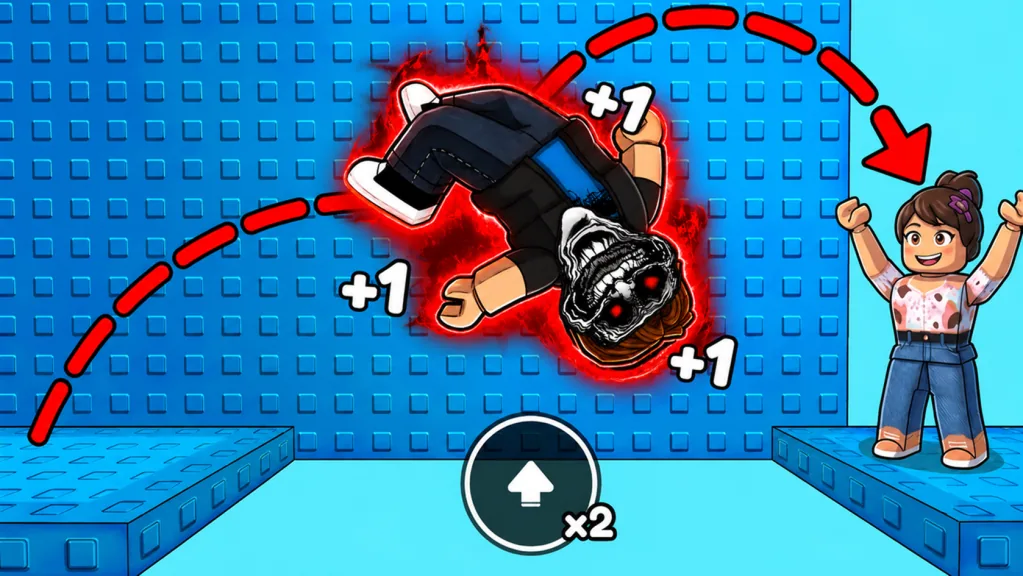
Every backflip officially gives +1 Speed, but more is not always the immediate answer. If you already clear a gap and slide off, train control rather than adding power.
Use broad platforms to measure how early you must release movement. Then transfer that timing to a smaller landing. Aim beyond the front edge but before the far edge, and reduce side corrections while airborne. On an elevated block, land first and rotate second.
Do not change Shoes, Trails, and training lanes all at once while practicing. One controlled variable makes the result readable.
A Repeatable Practice Session
| Pass | Goal | Rule |
|---|---|---|
| 1 | Route reading | Stop at every new visual cue |
| 2 | Alignment | Hit platform centers, ignoring speed |
| 3 | Flow | Remove pauses only from proven landings |
| 4 | Recovery | Identify where a restart is fastest |
| 5 | Full run | Use the same setup from start to finish |
If the entrance displays a recommended Level, use it as a preparation signal. Try entering to see whether it is advice or a hard gate.
Recover Without Losing the Lesson
Falling can return you to the start. You can also see a timed Revive? Teleport Back? premium offer. Since the wording does not name a destination, read the live prompt before paying.
For normal practice, a restart is useful: it lets you repeat early route cues and confirm that your method is stable. A paid recovery has more value late in a special attempt, but only if the current prompt clearly explains what it preserves.
Route Mistakes to Remove
- Treating the September 2026 Stage 1 through Stage 8 labels as a permanent map.
- Copying another player’s jump without comparing Speed.
- Following arrows while ignoring the actual landing surface.
- Turning sharply on a narrow platform before the avatar settles.
- Adding more backflips after an overshoot.
- Changing several upgrades between practice attempts.
FAQ
What is the +1 Backflip Phonk Escape parkour route?
It is the staged escape path through gaps and hazards. The exact layout can change, so follow current arrows and safe surfaces.
Do red arrows always show the next platform?
Use them to find the continuation, then inspect the actual landing before moving.
How do I stop overshooting narrow platforms?
Shorten the run-up, release movement earlier, and land along the platform’s center line before turning.
Are there always eight stages?
The route ran from Stage 1 through Stage 8 in September 2026. Check the current labels because updates can alter it.
Should I buy a revive after falling?
Only after reading the live destination and cost. The Revive? Teleport Back? label alone does not promise a fixed checkpoint return.