
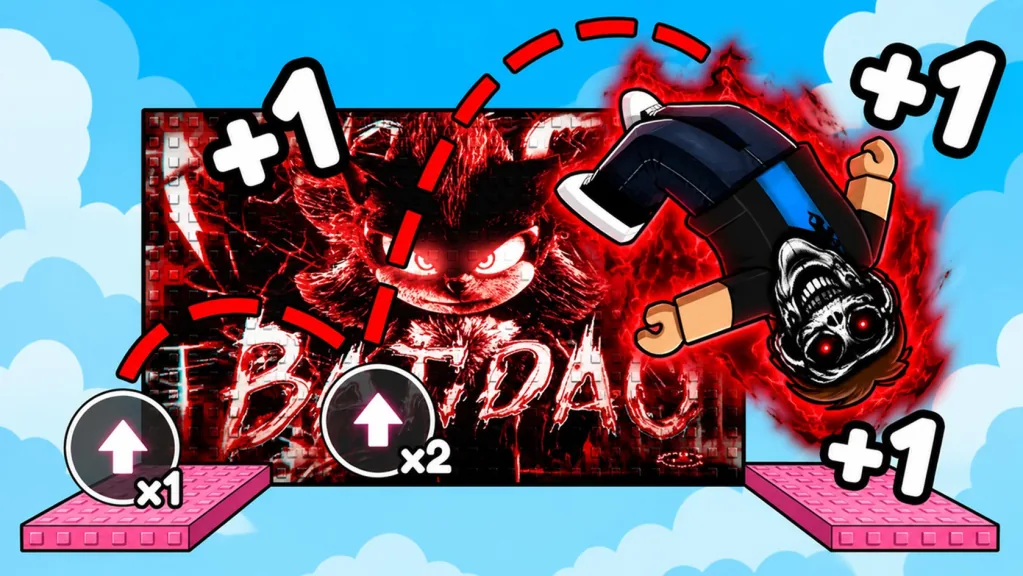
Press jump repeatedly to backflip. Each completed backflip gives you 1 Speed. That part is easy. The tricky part is knowing when to stop training so you can still land on a narrow platform instead of sailing over it.
How the backflip loop works
The game tells you to spam jump to backflip. Train on a wide, flat surface where a bad landing will not reset your run. Keep an eye on the Jumps counter while you flip because it shows your progress toward the next requirement.
Use this loop when you are getting started:
- Backflip in an open area.
- Watch the Jumps requirement and Level bar.
- Stop jumping before you enter a course.
- Try one careful approach jump.
- Adjust based on where you landed.
Separating training from traversal makes your movement much easier to read. If you keep mashing jump on the approach, you can add movement you did not plan for and ruin an otherwise simple landing.
Read the four progress signals separately
The HUD shows Jumps, Level progress, Current Speed, and Total Speed. Do not treat them as four versions of the same number.
| Display | Practical use |
|---|---|
| Jumps | Shows your progress toward the visible jump requirement. |
| Level | Shows longer progression and whether you can level up. |
| Current Speed | The number to check before a difficult approach. |
| Total Speed | A separate progress figure from Current Speed. |
The game does not spell out the exact relationship between Current Speed and Total Speed. Use Current Speed when judging your immediate movement. Read the Level and Jumps requirements straight from the screen, especially after an update.
Build Speed without losing accuracy
Extra Speed helps with long gaps, but it gives you less time to fix a bad line. You will feel this on narrow platforms, offset steps, lava sections, spikes, and hazard floors.
Learn a troublesome jump in passes. Start slowly and find the platform edges. Add a little Speed on the next try while keeping the same takeoff point. On the third try, change either your takeoff point or camera angle, not both.
One change at a time makes misses useful. If you overshoot, shorten the run-up or stop training before that obstacle. If you fall short, add a few backflips in a safe spot and repeat the same line.
Use Levels as checkpoints, not a reason to rush
The Level system gives your backflips a clear target. When you finish the current Jumps requirement, use Level Up if the button is available. Check your Speed again before heading back into the course.
For a simple personal benchmark, note your Jumps requirement, Current Speed, and the hardest section you can clear before leveling. Check those same three things afterward. You will quickly see whether the change helped, without needing a fixed formula that could become outdated.
Recover from failed attempts efficiently
Failure sends you back to the start. Running into the same obstacle again without changing anything usually wastes another attempt.
Work out what actually went wrong. Falling short points to distance or takeoff timing. Overshooting is a control problem. Touching a hazard usually means your route needs work. If you lost sight of the landing, line up the camera before you jump again.
Practice the approach on a safe platform, then make one proper attempt. A reset becomes less frustrating when you know exactly what to change.
A repeatable backflip training session
Start with a short backflip block in the hub. Let the Jumps counter track the work for you. Level up when the button becomes available, then check Current Speed. Test that movement on one obstacle you already know.
If the jump still feels controlled, carry on. If it suddenly feels wild, go back to a wide area and make a small adjustment. Train, check, test, and adjust. That rhythm is much more dependable than holding jump nonstop.
FAQ
Does every backflip give Speed?
Yes. The game states that every backflip gives +1 Speed. Check the counters if an event or update adds another bonus.
Why do I overshoot narrow platforms?
Higher Speed makes small landings less forgiving. Stop adding backflips before the obstacle and shorten your run-up.
Are Current Speed and Total Speed the same?
The game displays them separately and does not explain an exact conversion. Use Current Speed for immediate movement decisions.
What happens when I fail a course?
You return to the start. Use the attempt to identify whether distance, alignment, timing, or excess Speed caused the miss.
Should I spam jump during the whole course?
Rapid jumping works for backflip training. Near narrow platforms and hazards, deliberate inputs are safer.