
Win the Race Before It Starts
A good race needs comparable preparation and a route you can finish without resetting. The game invites you to race friends, but raw Speed is only part of the result. A clean run at manageable Speed beats a faster setup that falls into lava.
Before racing, agree on the start point, finish condition, and whether paid revives are allowed. Then take one solo practice run at your current Current Speed. If you cannot finish consistently, racing only adds pressure to a movement problem you have not solved.
Build Race-Ready Speed
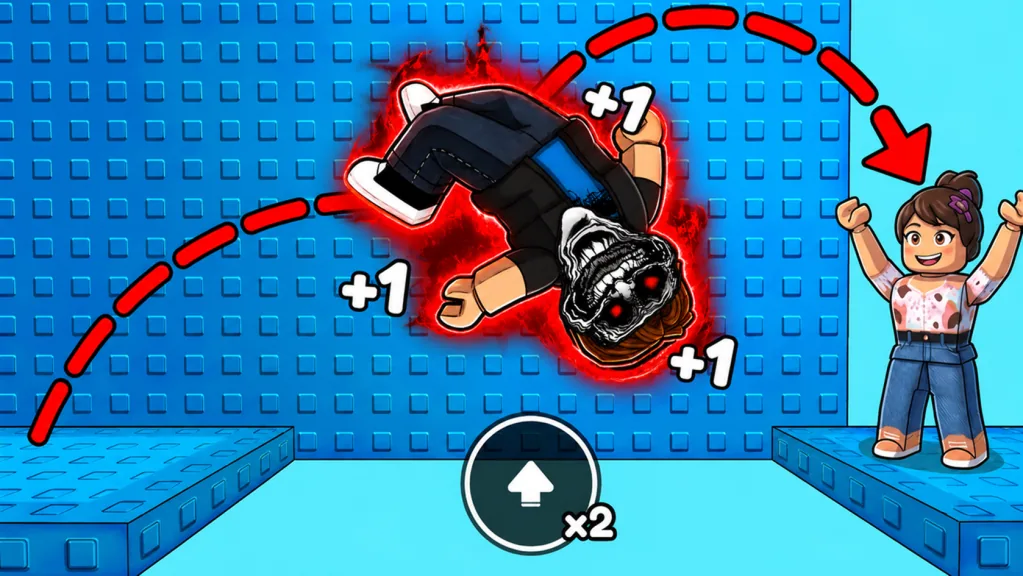
Every backflip gives +1 Speed. The interface also tracks Jumps, Level, Current Speed, and Total Speed. Use those displays to prepare, but do not copy a race requirement from someone else’s account.
Use this readiness test:
- fill one
Jumpsrequirement and reach the next Level; - enter the course without changing equipment again;
- complete the opening obstacle sequence twice;
- check whether you can stop near the center of narrow platforms;
- race only when both completions feel repeatable.
If you fall short of gaps, train again. If you overshoot, hold your Speed steady and improve braking. The training lanes can increase growth, and stronger lanes are tied to Rebirth progression, but they do not teach landing accuracy.
Set Fair Race Rules
The game supports shared-server competition, but its listing does not define a built-in matchmaking formula or equalized race mode. Create clear rules with your group.
| Rule | Recommended choice | Why it matters |
|---|---|---|
| Start | Same visible line or course entrance | Prevents rolling starts |
| Countdown | One player types or calls a simple countdown | Gives everyone the same launch cue |
| Finish | Current course completion message or agreed finish marker | Avoids disputes at doors or stage transitions |
| Revives | Decide before the race | Premium recovery changes the cost of a fall |
| Preparation | Disclose major boosts or race within similar progression | Keeps the result meaningful |
| Restarts | Full reset after a fall unless the group agrees otherwise | Makes mistakes comparable |
Do not claim the leaderboard automatically separates players by gear, Rebirth, or Speed. Leaderboard boards are visible in the hub, but their fixed categories and formulas are not established here. Read the headings in your live server.
Practice a Racing Line
Find the exit first
At each stage, locate the door, arrow, or next marker. Trace the platforms backward to your position. A direct line is useful only when it still gives you safe landings.
Aim for repeatable centers
The absolute shortest path often clips platform edges. In practice runs, aim for the center third of each landing. Once you can repeat the sequence, tighten the line gradually.
Reduce input before landing
Release forward movement just before touchdown. At higher Speed, holding input through the landing can carry you off the far edge before you can correct.
Stabilize at dangerous transitions
Lava walls, spikes, narrow blocks, and offset platforms punish rushed second jumps. A short pause can save an entire run. Use continuous movement only across sections you have already proven consistent.
Race the Course, Not the Other Avatar
Another player moving ahead of you can pull your camera and attention away from the route. Keep the next platform in the center of your screen. Your opponent’s line might reflect different Speed, equipment, or timing and may not work for your avatar.
Other players can tell you whether the race has started, whether a doorway is reachable, and whether someone crossed the finish. Keep your eyes on your own landing line.
Do not copy their takeoff point in real time unless you practiced it at your own Speed.
Handle Different Race Situations
| Situation | Best response |
|---|---|
| You lead after the opening | Keep the practiced line; do not add risky shortcuts |
| You fall slightly behind | Preserve the clean run and wait for an opponent error |
| Opponent uses a faster boost | Compare finishes only if the boost fits your agreed rules |
| You both fail the same obstacle | Restart together or return to the last agreed reset rule |
| You reach an unfamiliar layout | Slow down, read arrows, and treat it as a route test |
| A revive prompt opens | Follow the rule agreed before the countdown |
A race is decided by total completion time, not by who reaches the first gap first.
Improve Without Inventing a Timing System
The game listing does not define a universal race timer. You can still compare runs reliably:
- use the same course version and server session;
- begin from the same line;
- use the same countdown method;
- define completion by the same finish message or marker;
- record only clean runs under the same revive rule.
If the live game shows a timer or leaderboard category, use its current label. Do not assume an old board measures the same thing after an update.
Speed Versus Accuracy
Think of progression as two separate upgrades:
- stat upgrade: more Speed from backflips, Shoes, training lanes, Rebirth access, or a specifically labeled boost;
- execution upgrade: better camera alignment, earlier release, cleaner route reading, and fewer resets.
Increase the stat only when execution remains stable. If your completion rate drops, stop adding Speed until your landing rhythm catches up.
This makes race preparation easy to evaluate. A new upgrade is useful when it lowers total clean-run time, not merely when it makes the hub counter larger.
Recover From a Race Mistake
One wrong move can return you to the start. The game can also show a timed Revive? Teleport Back? premium offer.
For fair casual races, the simplest rule is to decline and restart after a fall. If your group allows revives, agree on that before racing and read the live prompt carefully; its exact return point is not established.
After the race, name the failure rather than blaming Speed in general:
- wrong route;
- diagonal camera;
- late release;
- rushed chain jump;
- obstacle clipped at the edge.
Practice that one issue before the rematch.
Common Racing Mistakes
Training immediately before every rematch
Changing Speed changes jump distance and braking. Keep the same setup for several races so you can compare execution.
Chasing a player with different progression
Visible Trails, Auras, Shoes, or Rebirth access can indicate a different setup. Race within agreed rules rather than assuming the server equalizes everyone.
Taking shortcuts you have never completed
A theoretical faster line is slower when it resets the run. Prove a shortcut in solo practice before using it under pressure.
Ignoring update changes
Earlier versions used numbered stages, but route layout and rewards can change. Take a scouting run when arrows, doors, or platforms look different.
FAQ
How do I race friends in +1 Backflip Phonk Escape?
Join the same server, choose a common start and finish, agree on a countdown and revive rule, then race the live course. The official description explicitly supports racing friends and other players.
Is the fastest player always the one with the most Speed?
No. Speed helps traversal, but missed landings and resets add more time than a controlled route. Compare clean completions.
Does the game match players by Level or Rebirth?
The game listing does not describe a matchmaking or equalization formula. Compare visible progression and set your own fair rules.
Should races allow paid revives?
Decide before starting. Disallowing revives creates the clearest comparison because every fall has the same consequence.
How can I improve my race time?
Keep the same setup for several attempts, find the first inconsistent obstacle, practice its alignment and release timing, then add Speed only after the route is stable.